
David Owasi
Templates & Resources
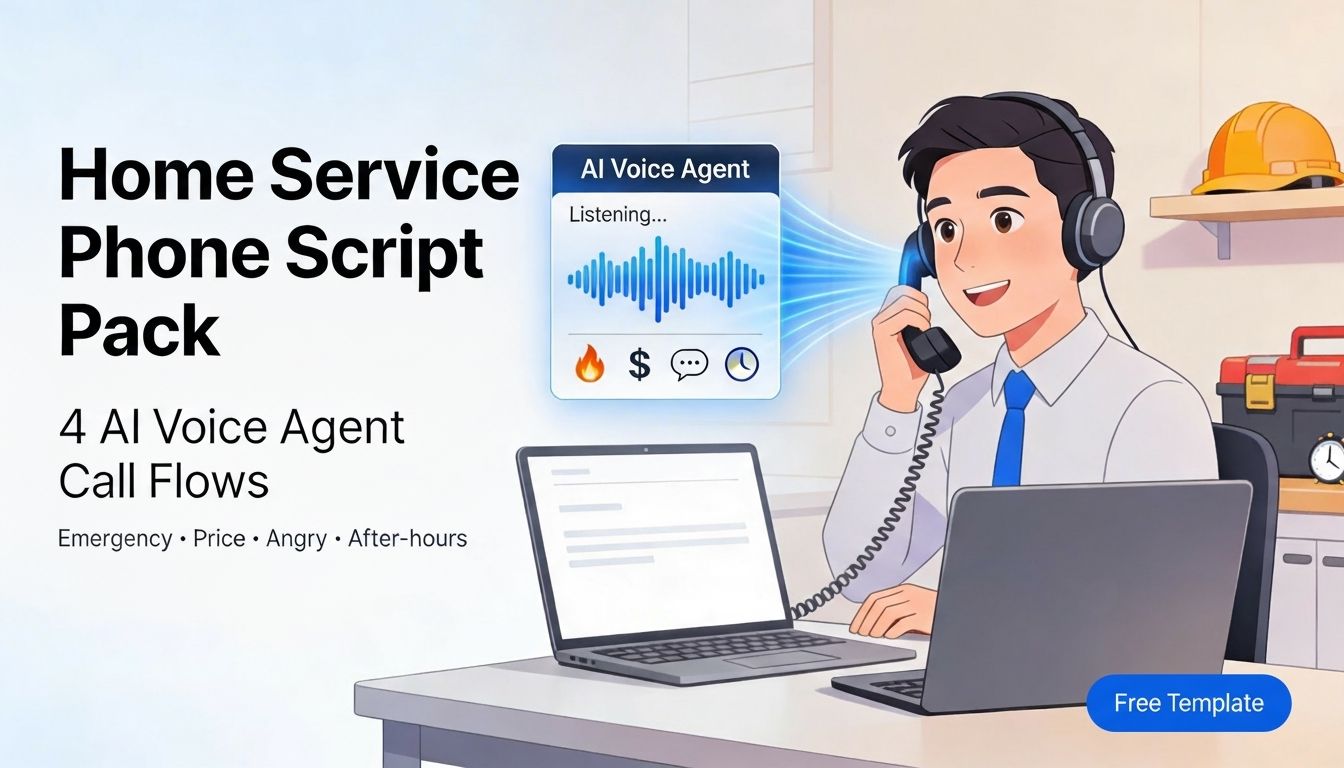
The Home Service Phone Script Pack That Actually Ships: 4 Operator Flows for Your AI Voice Agent (Free Template + PDF)
By OutreachGenius AI
Your phone line is your dispatch center, sales desk, and reputation manager. This post gives you a practical script pack for an AI voice agent—four operator-grade call flows with trigger phrases, required fields, decision rules, and hard handoff conditions (a modular approach that aligns with common AI script best practices).
Download the Script Pack (Free)
Google Doc template (make your own copy):
Download Here
Version 1.0 - Last updated: Feb 2026
What’s inside
Emergency call flow: triage and route safely.
Price shopper flow: quote ranges without overpromising and convert to booking.
Angry customer flow: de-escalate and resolve with clear lanes.
After-hours flow: capture lead, route urgency, schedule next step.
Each flow is written so you can implement it as a separate intent in your AI voice agent, and each includes the minimum data your dispatcher/CRM needs.
The OutreachGenius 4D method
Every flow follows the same backbone so your AI stays consistent:
Detect: Identify intent quickly and confirm once.
De-risk: Check safety/urgency and set expectations.
Decide: Choose one outcome (book, dispatch, estimate, escalate).
Dispatch: Confirm next steps and send written confirmation (SMS/email).
Flow 1: Emergency call (triage + route)
Goal
Route emergencies fast and safely; triage and dispatch, don’t diagnose.
Trigger phrases
“Water everywhere,” “no heat and it’s freezing,” “burning smell,” “sparks,” “gas smell,” “sewage backup,” “ceiling dripping.”
Talk track (AI script)
AI: “Thanks for calling [Company]. I can help quickly. First—are you in immediate danger right now, like fire, a strong gas smell, sparks, or someone needing medical help?”
If YES / UNSURE (treat as danger):
AI: “Please hang up and call emergency services now. If you can safely tell me your address first, I’ll note it for our on-call team.”
AI: “What’s the address?”
AI: “What’s the best callback number in case we get disconnected?”
AI: “I’m connecting you to a manager/on-call lead now.”
→ Hand off to human/on-call lead
If NO (safe to proceed):
AI: “Got it. What’s happening right now—water leak, no heat, no AC, electrical issue, drain/sewer backup, or something else?”
AI: “Is it getting worse quickly—like active flooding, strong odor, or complete loss of heat?”
AI: “What’s the service address?”
AI: “What’s the best callback number?”
AI: “Any access notes—gate code, parking, pets, or special instructions?”
AI: “I’m going to summarize to confirm I got it right: [1 sentence]. You’ll receive a confirmation text shortly.”
Required fields (CRM payload)
service_address; caller_name; callback_number; problem_type; severity (hazard/urgent/standard); access_notes; summary_1_sentence.
Hard handoff conditions
Gas smell, sparks/arcing, smoke/fire, injuries, panic, or anything suggesting immediate danger.
Flow 2: Price shopper (range + value + convert)
Goal
Provide a useful range, protect accuracy, and convert to booking or an estimate.
Trigger phrases
“How much do you charge?”, “What’s your call-out fee?”, “Just tell me the price.”
Talk track (AI script)
AI: “Totally—happy to help with pricing. To make sure I don’t misquote you, can I ask two quick questions?”
AI: “What service are you looking for—repair, installation, maintenance, or something else?”
AI: “What’s going on right now, in one sentence?”
AI: “What area are you in (city or neighborhood)?”
AI: “Thanks. For jobs like that, the typical range is [X–Y]. That usually includes [what’s included]. The exact total depends on [1–2 variables], and we confirm price before any work begins.”
AI: “Would you like the soonest available appointment, or do you prefer a quote/estimate visit first?”
If they push for an exact total:
AI: “I can’t promise an exact total without seeing [key detail], but the quickest path is to reserve a slot and have the tech confirm the price on-site before any work begins.”
Required fields (CRM payload)
service_type; job_summary_1_sentence; address_or_area; preferred_time_window; callback_number; price_sensitivity (inferred).
Hard handoff conditions
Binding quotes without details, or contract/insurance/legal commitments.
Flow 3: Angry customer (de-escalate → resolve)
Goal
De-escalate first, then route to the right resolution lane (reschedule, redo, billing review, manager callback).
Trigger phrases
“This is unacceptable,” “I’m leaving a bad review,” “I want a refund,” “Your tech didn’t show.”
Talk track (AI script)
AI: “I hear how frustrating that is, and I’m sorry you’re dealing with it. I’m going to help get this resolved—can you tell me what happened?”
AI: “To fix this quickly, I’m going to ask three things: your name, the service address, and what outcome you want.”
AI: “What’s your name?”
AI: “What’s the service address?”
AI: “When was the visit or scheduled appointment?”
AI: “What went wrong—quality of work, no-show/delay, billing, or something else?”
AI: “What would make this right—redo, reschedule, refund review, or a manager call?”
Resolution lane A (Scheduling / no-show):
AI: “I understand why you’re upset. I can book the earliest priority slot and request a manager callback to confirm the details.”
AI: “What time window works best for you?”
Resolution lane B (Quality issue / redo):
AI: “Thanks for explaining. I’m going to schedule a return visit so we can inspect and correct it.”
AI: “What’s the soonest time someone can be on-site?”
AI: “We’ll confirm the plan before any work starts.”
Resolution lane C (Billing dispute):
AI: “I’m sorry to hear about the billing issue. I’m going to document it and escalate it for review.”
AI: “Do you have the invoice number, or the phone/email used on the booking?”
Close:
AI: “Let me confirm the next step: [one sentence action]. You’ll receive a text/email confirmation.”
AI: “Is there anything else I should note for the team?”
Required fields (CRM payload)
customer_name; service_address; callback_number; original_job_date; issue_category; desired_outcome; summary_1_sentence; escalation_required (yes/no).
Hard handoff conditions
Threats, harassment, discrimination, legal claims, or refusal to calm down.
Flow 4: After-hours (capture + route + promise)
Goal
Capture the lead, check urgency, and schedule the next step (or page on-call).
Talk track (AI script)
AI: “You’ve reached [Company] after hours. I can help you book the next available time, and if this is urgent I can contact the on-call team.”
AI: “Is this an emergency—like active flooding, no heat in freezing weather, or an electrical hazard?”
If YES:
AI: “Understood—let’s handle it right now.”
→ Run the Emergency Flow.
If NO:
AI: “No problem. What service do you need?”
AI: “What’s the service address?”
AI: “What’s the best callback number?”
AI: “What’s a good time window tomorrow for a call or visit—morning, afternoon, or evening?”
AI: “Do you want me to reserve the next available appointment, or schedule a callback first?”
Close:
AI: “I’m going to summarize: [1 sentence]. You’ll receive a confirmation text with your request details.”
AI: “If anything becomes unsafe overnight, call emergency services.”
Required fields (CRM payload)
caller_name; callback_number; service_address; issue_summary_1_sentence; urgency; callback_window; preferred_next_step (book/callback).
Hard handoff conditions
Anything that starts sounding like an emergency after you collect details.
Download the Script Pack (Template + PDF)
Google Doc template (make your own copy):
Download Here